|
MoD loses battlefield rights case 18 May 2009
The judgement the MoD appealed against said "right to life" meant it had a legal duty to supply proper equipment. The rulings centred on a case brought by the family of Pte Jason Smith, who died of heatstroke while serving with the Territorial Army in Iraq in 2003. However, the MoD has been given leave to appeal again, to the House of Lords. The earlier High Court ruling - upheld by the Court of Appeal's decision on Monday - had also said inquests of military personnel had to be more wide-ranging and families should be able to access legal aid. |
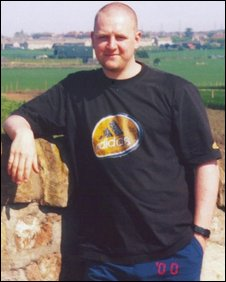 The death of Pte Jason Smith sparked legal action by his family |
Pte Smith's mother Catherine said she was "overwhelmed" with the verdict, and was angry at the MoD for going so far to fight the case. "I feel I have done something to protect the young lads that are coming in [to the forces] now," she said.
Armed Forces Minister Bob Ainsworth said they were "surprised and disappointed" by the judgement. "While it does not affect the position concerning Pte Smith, it potentially has very serious implications for the ability of our forces - and those of our allies - to conduct military operations overseas."
Defence sources have said the ruling will make it harder for military commanders forced to make rapid and difficult decisions on the battlefield.
Mr Ainsworth said they were studying the judgement and and considering whether to appeal to the House of Lords.
'No guarantees'
They would, in the meantime, await a date for a fresh inquest into the death of Pte Smith and would "as usual offer the coroner our full co-operation", he added. The MoD had argued the European Convention on Human Rights (ECHR) could not be guaranteed in certain situations. It said that in the heat of battle, the UK "could not secure the rights and freedoms which the ECHR seeks to guarantee".
The ruling by three judges, headed by Master of the Rolls Sir Anthony Clark, could lead to more families wishing to sue the MoD for negligence.
However Jocelyn Cockburn, solicitor for Pte Smith's mother Catherine, said the case was never about opening the door to legal actions and compensation claims, but was about human rights.
Permission to appeal again was granted to the MoD on condition that the secretary of state for defence paid the legal costs whether they won or lost.
The legal process began with a judicial review requested by Pte Smith's family, following the inquest into his death. The MoD accepted that the Human Rights Act applied to Pte Smith, as he died on a British military base. However, in a judgement last April, Mr Justice Collins ruled more widely that the MoD had an obligation to avoid or minimise risks to the lives of its troops, wherever they were serving - even while on patrol or in battle. Otherwise, he said it risked breaching the "right to life" enshrined in the ECHR.
The MoD appealed amid fears that the judgement raised serious questions over sending troops into combat abroad. Lawyers for Pte Smith's family had said if the MoD lost its appeal, it would be forced to provide better protection for troops abroad - and be more open at inquests into the deaths of British servicemen and women.
'Common sense'
Speaking outside the Court of Appeal, Ms Cockburn said the "right decision" had been made. "It's a very basic thing that the state must make reasonable efforts to provide protection to soldiers wherever they are, and when we're sending them to fight on our behalf, that's the very least we can do". She added: "The proposition of the Ministry of Defence that these rights should be removed from them when they are deployed abroad on active service doesn't reflect well on our government." She said earlier that success in their case would "create certainty in the law" for soldiers when they are sent out to fight, which she said was "essential" for soldiers and commanding officers.
But Labour MP and former army major, Eric Joyce, said it was difficult to see how the ruling could be applied in real operations. "That is something the MoD is now going to have to grapple with. The MoD takes the duty of care very seriously, but of course commanders in the field… have to sometimes make percentage judgements. "It's not clear to me how that can be done in the pure context of the Human Rights Act," he said.
Shadow defence secretary Liam Fox acknowledged the government's moral obligation to minimise risks to service personnel but said it was "nonsensical and absurd" to apply human rights laws in a war zone. "Our troops and commanders have enough to worry about on the battlefield without worrying about where the next legal attack will come from," he added.
The Equality and Human Rights Commission, which intervened in the case, said the MoD would now have to provide proper protection, including adequate equipment and medical facilities. The commission's group legal director, John Wadham, said: "Our service personnel are sometimes required to lay down their lives for this country. In return, we should afford them the same human rights protection as every other citizen." While accepting that the lives of troops in combat situations could not be protected at all costs, he said: "We can do our best to ensure they remain as safe as possible".
|
By Caroline Wyatt, BBC News defence correspondent At the heart of the ruling was the issue of whether the Human Rights Act - in particular article 2, the right to life - could and should apply to service personnel outside military bases abroad, which are already deemed part of UK jurisdiction. The High Court says it does, even if troops are on patrol or in battle.
However, the judges said the ruling concerned matters of such importance that they gave leave to the MoD to appeal. The MoD will now be looking very carefully at what chances an appeal might have in the House of Lords: The end of the legal road for the MoD if a ruling there went against it too.
The MoD has called this "an attempt to insert lawyers into the chain of command in the middle of battle", saying it would create greater risks. Catherine Smith's lawyers argue that simply isn't the case and that all the ruling does is ensure the MoD offers the greatest possible protection and care for those risking their lives. |
